Who Can Actually Discover a Listing, and When?
Five levels, three questions and no side elevated: a shared way to describe who can discover a listing, who can access it, and when that shifts.
Frameworks · Shared vocabularies the industry can use and adapt.


The private listing debate has a primary vocabulary problem. Terms like office exclusive, private network, delayed marketing and pre-marketing get used as if everyone agrees on what they mean, but depending on the market, the brokerage and whoever named the program, the same term can describe a listing seen by a dozen agents or one seen by thousands.
That gap in common understanding compounds confusion and empowers posturing. It makes policy discussions and enforcement more convoluted and conflictual, and it makes the data harder to trust and utilize.
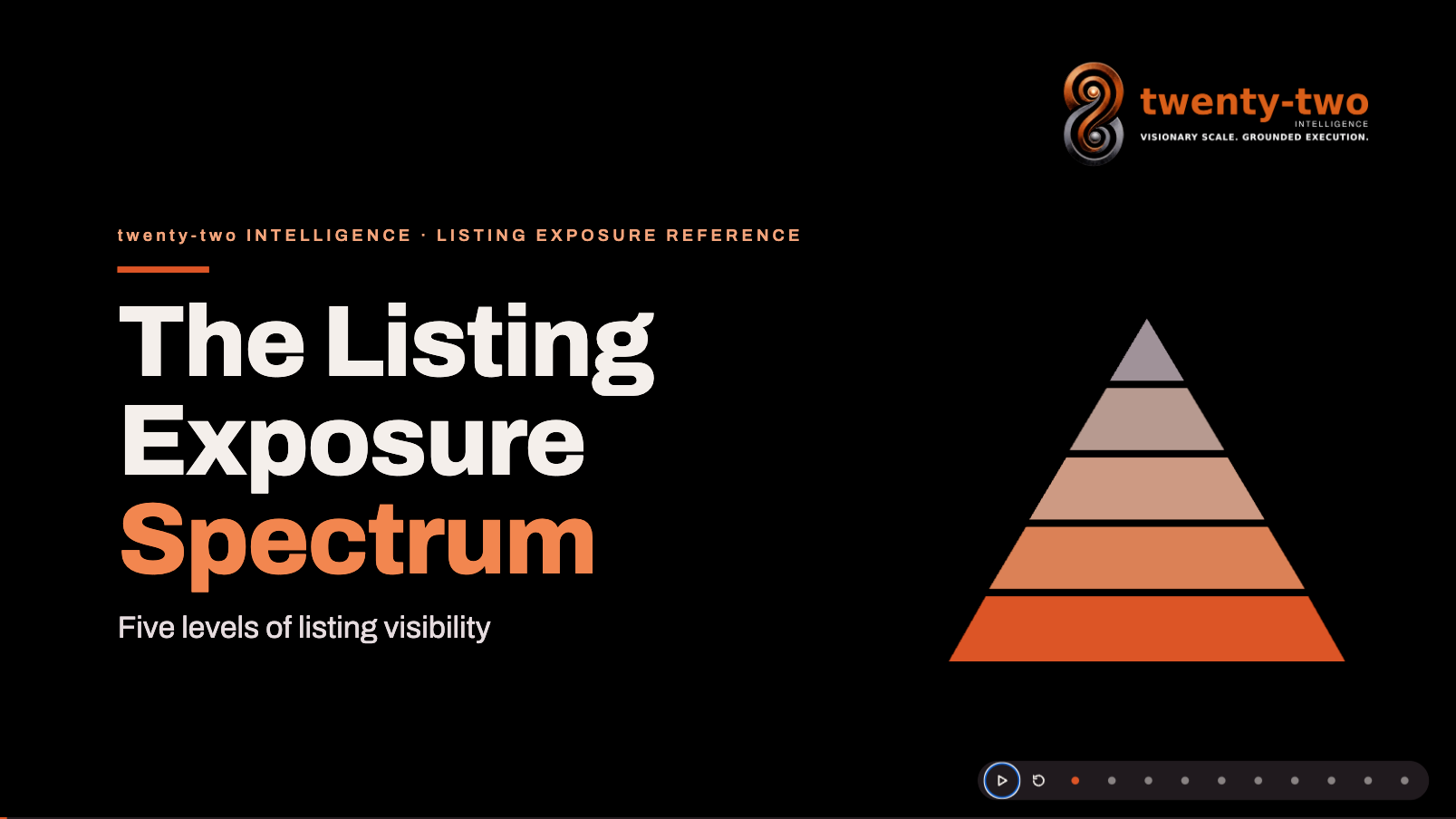
So I've been giving real thought to how to establish a common understanding, a through line for what all the various labels mean in practice, that doesn't take a side on whether the listing and its associated business strategies are good or bad. The goal is to describe what's actually happening and what it means for a functioning two-sided marketplace — who can discover a listing, who can access it, and when either of those shifts. The result is the Listing Exposure Spectrum.
Labels and exposure are different things
Most of the language we use today describes a status, a policy option or a marketing program. Active and Coming Soon tell you where a listing sits in the MLS workflow. Office exclusive and delayed marketing tell you which option a seller chose under local rules. Private networks and premarketing describe how a brokerage or platform packaged its offering. None of them tell you how many buyers can realistically discover the home.
An Active listing with IDX and syndication withheld reaches a much smaller audience than one showing up across every public channel, even though both carry the same status. A "private network" can mean one office or a national firm. Once you start looking at listings this way, it's hard to stop.
Five levels of listing visibility
Relational Exposure. The seller already knows the buyer and there's no real open marketing, like a tenant or a neighbor who buys the home. FSBO doesn't automatically land here, since an owner can, and often does, market publicly. Only the known-buyer, truly unmarketed version belongs at this level.
Gated Exposure. Awareness is limited to a defined private audience, such as one brokerage or a closed network. What matters most here is how big and how open that audience really is, and that needs to be assessed rather than assumed.
Conditional Exposure. Buyers may see the home through selected channels, at selected times or under stated conditions. Coming Soon, named public platforms and phased launches tend to live here, and public visibility can be substantial, especially for niche properties or well-matched buyers, without broad distribution.
Limited Exposure. Real estate professionals can discover the listing, but direct public visibility is restricted. Delayed marketing exempt listings are the clearest example, where MLS access remains and IDX and syndication wait.
Full Exposure. The home is offered through the MLS and a broad set of public channels. Even at this level, Active status by itself doesn't guarantee the listing shows up on every website.
Three questions to ask at every level
Who can discover it, who can access it, and when does exposure shift?
The last one is the one we see skipped most often. A listing can start in a gated network, move to Coming Soon and end up fully public in a matter of weeks, or get pulled back if the seller's plans change, especially during challenging market conditions. If we only record where it ended up, we lose most of what actually happened along the property's journey, and what might be learned from it.
Why the research keeps disagreeing
Over the past year, MLSs, brokerages, portals, academics and regulators have all published studies on what these various listing strategies do to price. The findings point in nearly every direction, and each one tends to get quoted by whoever it helps most. When you look closer, most of them aren't measuring the same thing. One study defines private as a sale with zero days on market. Another looks at office exclusives. Another combines Coming Soon with private exclusives, and when a different study separated those two, they moved in opposite directions.
I don't think more research fixes that on its own. Until we can say what level of exposure a listing actually had, every new number is going to add to the noise more than it settles anything.
For the detail, read Why the research on private listings keeps disagreeing.
A couple of caveats
This is a conceptual framework, not an official MLS classification or a measured audience score. Levels can overlap, a listing can move between them, and exposure by itself doesn't predict price. What we haven't done yet is measure exposure consistently enough for professionals and consumers to see what correlations actually exist. We're holding it loosely and expect it to get better as more people push on it.
Exposure goals start at origination, and every system and policy after that point should be able to read them, honor them and measure them.
Exposure and single point of entry
Right now a listing's exposure is scattered across a status, a delayed-marketing flag, IDX and syndication choices and seller internet-display instructions. Each of those is a separate setting, and none of them conveys the exposure level on its own.
That gets even more important in the era of single point of entry conversations, the idea that an agent enters a listing once and it flows to every MLS and platform that needs it. If that's where we're headed, whatever travels with the listing needs to make clear where it's allowed to go and when. Should the exposure spectrum be defined on its own terms as the foundational element, rather than pieced together from a status and a handful of switches? It's a fair and potentially important framing question to ask.
Use it, adapt it, cite it
This is offered as a conceptual starting point, in the hope that the Listing Exposure Spectrum can become a uniting principle that every perspective can leverage, adapt and build on, with attribution to twenty-two Intelligence. A universal vocabulary only works if it's actually adopted, and the more leaders, advisors and technology partners who put it to work, the more useful it becomes for practitioners and consumers.